Introduction At the very heart of chemical engineering lies the discipline of transport phenomena, a subject that unifies the principles of momentum transfer (fluid mechanics), heat transfer, and mass transfer. These three pillars describe how momentum, energy, and matter move through physical systems. Whether it’s designing a heat exchanger, modeling pollutant diffusion, or … [Read more...]
Superheated Steam Properties Calculator
Superheated Steam Properties Calculator Enter Pressure with either Temperature or Degree of Superheat. Calculates v, ρ, h, s, u and heat capacities (Cp, Cv, k). Exports to Excel with live formulas. Input Mode Pressure + Temperature Pressure + Superheat (ΔT) … [Read more...]
Saturated Steam Properties Calculator
Saturated Steam Properties Calculator Enter either Temperature or Pressure. Calculates saturation and properties: vg, ρg, vf, ρf, hf, hfg, hg, sf, sfg, sg. Export to Excel — changing inputs there updates outputs automatically. Input Mode By Temperature By Pressure Temperature … [Read more...]
Digital Twins in Process Safety: Science Fiction or New Industrial Standard?
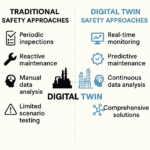
Introduction The term “digital twin” may once have sounded like science fiction, but today it is a buzzword transforming industries across the globe. From aerospace to automotive, and increasingly in the chemical and process industries, digital twins are moving beyond hype into real-world applications. In particular, their role in process safety has garnered attention, as … [Read more...]
Leading vs Lagging Safety Indicators: Complete Guide for Safety Professionals

Introduction In industrial environments such as chemical plants, refineries, and manufacturing units, safety performance measurement is one of the most critical aspects of operational excellence. While safety policies, risk assessments, and training sessions are vital, organizations need quantifiable ways to evaluate whether these measures are working. This is where leading … [Read more...]
Energy Saving Opportunities in the Chemical Industry: Strategies & Best Practices
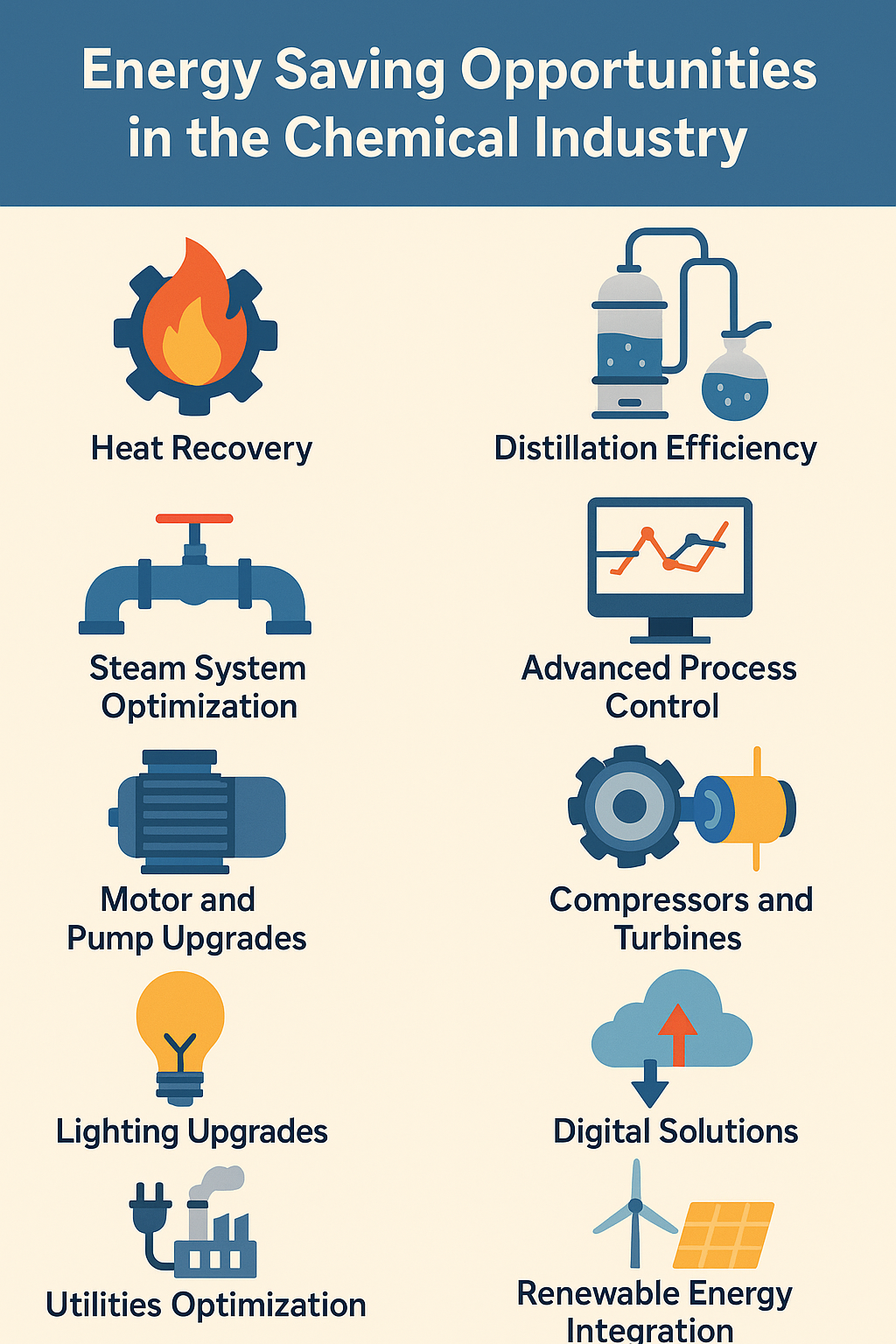
Introduction The chemical industry is one of the largest energy-consuming sectors globally. From ammonia production to refining and polymer manufacturing, energy in the form of electricity, steam, fuel, and cooling is integral to operations. With rising energy costs, stricter environmental regulations, and the global push toward net zero emissions, improving energy … [Read more...]
Process Control and Instrumentation: Essentials for Chemical Engineers

Introduction In modern chemical plants, where safety, efficiency, and reliability are paramount, process control and instrumentation serve as the nervous system. From regulating reactor temperatures to ensuring distillation columns achieve the desired purity, these tools allow engineers to monitor and manipulate processes to achieve desired outcomes. This article provides … [Read more...]
Boiler Walkdown Check: A Comprehensive Guide for Chemical and Process Engineers

Introduction Boilers are the workhorses of industrial plants, providing steam and hot water for power generation, heating, and numerous process applications. In chemical and process industries, they are critical for operations such as distillation, evaporation, drying, and sterilization. Because boilers operate under high pressure and temperature, they pose significant risks … [Read more...]
Unit Processes in Chemical Engineering

Introduction While unit operations involve the physical steps in a process, unit processes in chemical engineering refer to the chemical transformations that convert raw materials into desired products. These processes form the chemical core of industries such as pharmaceuticals, petrochemicals, fertilizers, and specialty chemicals. This in-depth guide provides a … [Read more...]
Are Chemical Engineers Prepared for the Shift Towards Green Technologies and Sustainability?

Introduction As the world faces escalating climate change, energy crises, and resource depletion, the chemical industry is under growing pressure to decarbonize and become more sustainable. Governments are tightening emissions targets, investors are demanding ESG transparency, and consumers are shifting preferences toward eco-friendly products. In this transformation, … [Read more...]
- « Previous Page
- 1
- 2
- 3
- 4
- 5
- 6
- …
- 25
- Next Page »