Introduction
Fluid mechanics is one of the core pillars of chemical engineering, governing everything from the flow of gases in a pipeline to the mixing of liquids in a reactor. Mastery of this subject is essential not only for academic success but also for practical applications in industries such as oil & gas, pharmaceuticals, water treatment, and petrochemicals.
This guide provides a student-friendly overview of key fluid mechanics concepts, laws, equations, and real-world applications—all tailored to the needs of chemical engineering students.
1. What is Fluid Mechanics?
Fluid mechanics is the branch of physics concerned with the behavior of fluids (liquids and gases) at rest and in motion. It is divided into two main categories:
- Fluid Statics: Study of fluids at rest
- Fluid Dynamics: Study of fluids in motion
In chemical engineering, fluid mechanics helps in designing equipment like pumps, compressors, pipelines, flow meters, and heat exchangers.

2. Properties of Fluids
Understanding fluid properties is foundational to solving any flow-related problem.
Key Properties:
- Density : Mass per unit volume
- Viscosity: Internal resistance to flow
- Pressure: Force per unit area
- Surface tension: Cohesive force at fluid interfaces
- Vapor pressure: Pressure at which a fluid’s vapor is in equilibrium with its liquid
3. Fluid Statics
Fluid statics deals with fluids at rest and the pressure they exert.
Key Concepts:
- Hydrostatic Pressure: P = rho g h
- Manometry: Measuring pressure using U-tube and inclined manometers
- Buoyancy and Archimedes’ Principle
Applications:
- Tank level measurement
- Sizing pressure vessels
- Floating/sinking of solids in liquids
4. Fluid Dynamics
Fluid dynamics covers the motion of fluids and is central to process engineering.

Momentum Balance:
Used for analyzing forces on bends, nozzles, etc.
5. Types of Flow
A. Laminar vs Turbulent Flow
- Laminar: Smooth, orderly, Re < 2100
- Turbulent: Random, chaotic, Re > 4000
- Transition: 2100 < Re < 4000
B. Compressible vs Incompressible
- Gases are often compressible
- Liquids are usually treated as incompressible
6. Reynolds Number (Re)
A dimensionless number that predicts flow regime:

Applications:
- Pipe flow analysis
- Reactor design
- Mixing behavior
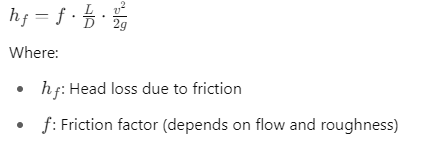
7. Head Loss and Friction
Darcy-Weisbach Equation:
Minor Losses:
- Due to fittings, valves, bends
- Use equivalent length method or loss coefficients
8. Pumps and Compressors
Pumps:
- Add energy to liquids
- Types: Centrifugal, positive displacement
Compressors:
- Add energy to gases
- Types: Reciprocating, rotary, centrifugal
Key Parameters:
- NPSH (Net Positive Suction Head)
- Pump curve
- Efficiency
9. Flow Measurement Devices
- Orifice Meter
- Venturi Meter
- Pitot Tube
- Rotameter
- Ultrasonic Flow Meters
These are selected based on accuracy, fluid type, and installation constraints.
10. Dimensionless Numbers in Fluid Mechanics
- Reynolds Number (Re): Flow regime
- Froude Number (Fr): Gravity effects
- Mach Number (Ma): Compressibility
- Weber Number (We): Surface tension vs inertia
These help generalize problems and apply scaling laws.
11. CFD in Modern Chemical Engineering
Computational Fluid Dynamics (CFD) allows simulation of complex flow phenomena. CFD is the use of computer simulations to analyze and predict fluid flow, heat transfer, and related physical phenomena by solving mathematical equations governing fluid motion. It helps chemical engineers optimize designs and processes without physical testing.
- Mixing patterns
- Heat transfer
- Multiphase flows
Tools like ANSYS Fluent, OpenFOAM, and COMSOL are widely used in industry.
Conclusion
Fluid mechanics is more than just equations—it’s the language of flow, energy, and momentum in chemical engineering. A strong grasp of its fundamentals allows engineers to design safer, more efficient, and more sustainable processes.
Whether you’re solving pump sizing problems or simulating multiphase flows in a reactor, fluid mechanics is a critical skill. Keep practicing problems, visualizing flow systems, and exploring real-world case studies.
Tip: Use tools like MATLAB, Python, or Excel to solve flow problems and validate design equations.
Stay curious. Stay fluid. Happy engineering!