📘 Introduction
Distillation is one of the most widely used separation techniques in the chemical and process industries. From refining crude oil to purifying solvents, distillation columns play a crucial role in countless chemical engineering processes.
But designing an efficient distillation column isn’t just about stacking trays or packing a tower — it’s about balancing thermodynamics, fluid dynamics, and separation efficiency. In this post, we’ll break down the key parameters for column design and common issues engineers face during operation.
⚗️ 1. Basics of Distillation
Distillation works on the principle of relative volatility. Components are separated based on their boiling points by repeated vaporization and condensation inside the column.
There are two main types of distillation columns:
- Tray Columns (Bubble Cap, Sieve, Valve)
- Packed Columns (Structured or Random Packing)
📐 2. Key Parameters in Column Design
🔺 a. Feed Composition & Flow Rate
- Affects the required number of theoretical stages
- Determines location of feed tray or feed zone
🌀 b. Reflux Ratio
- Ratio of liquid returned to the column vs product withdrawn
- Higher reflux → better separation but higher energy cost
🧊 c. Number of Theoretical Stages
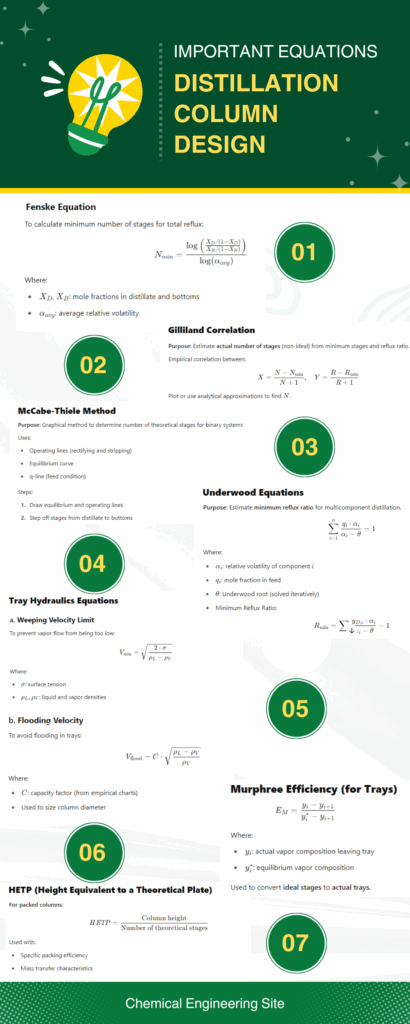
- Calculated using McCabe-Thiele or Fenske-Underwood-Gilliland method
- Determines column height
🔥 d. Boil-Up Ratio
- Impacts reboiler duty and separation efficiency
📊 e. Tray or Packing Efficiency
- Real columns don’t achieve perfect separation per stage
- Murphree efficiency adjusts ideal stage count
⛓️ f. Column Diameter
- Based on vapor and liquid traffic
- Must avoid flooding, weeping, and entrainment
🌡️ g. Operating Pressure
- Impacts volatility, energy use, and equipment cost
- Vacuum used for heat-sensitive or high-boiling mixtures
🔍 3. Common Design Equations
🛠️ 4. Troubleshooting Tips
⚠️ Problem 1: Flooding
Cause: Excess vapor flow
Fix: Reduce reflux ratio, increase diameter
⚠️ Problem 2: Weeping or Dumping
Cause: Low vapor velocity
Fix: Reduce tray spacing or pressure drop
⚠️ Problem 3: Entrainment
Cause: Liquid carried by vapor to upper trays
Fix: Check vapor-liquid load balance, install demister pads
⚠️ Problem 4: Foaming
Cause: High surface tension liquids
Fix: Use anti-foam additives, lower liquid holdup
⚠️ Problem 5: Poor Separation
Cause: Inaccurate feed composition or wrong tray count
Fix: Re-evaluate mass balance, check feed location
📉 5. Design Tools Used
- Aspen HYSYS or Aspen Plus
- ChemCAD
- Excel + McCabe-Thiele for quick estimates
📚 Conclusion
Designing a distillation column involves far more than just sizing a vessel. It requires careful attention to mass transfer, thermodynamics, hydraulics, and operation dynamics. With the right design and maintenance, a well-tuned column can deliver high purity with optimal energy use.
🔗 Further Resources
- Book: “Separation Process Principles” by Seader and Henley
- Course: Free NPTEL Course: Process Equipment Design
- Master Guide to Chemical Engineering