The Misconception: A Dying Profession
In recent years, conversations around the future of work have been dominated by terms like automation, AI, machine learning, and digital transformation. As industries evolve, some have questioned whether traditional disciplines such as chemical engineering are becoming irrelevant.
The assumption is that new-age technologies will replace chemical engineers, rendering the discipline obsolete. This narrative is catchy — but it’s far from the truth.
The reality? Chemical engineering is more relevant today than ever before — just in ways that are evolving.
Why the “Obsolete” Myth Exists
Several factors feed into the misconception that chemical engineering is on its way out:
- Automation of Industrial Processes
Plants that once required large teams of engineers now rely heavily on automated control systems, DCS (Distributed Control Systems), and AI-based monitoring. This leads to the belief that human expertise is less essential. - Shift Towards Digital Skills
The rise of data-driven decision-making, process simulations, and AI-powered design tools means that traditional “hands-on” process roles are being redefined. - Decline in Some Conventional Industries
Oil & gas, a major employer of chemical engineers, has seen market fluctuations and a push towards renewable energy, leading to concerns over job security. - Misinformation Among Students
Many young professionals entering STEM fields are told that chemical engineering is outdated compared to computer science or AI-related courses.
While these observations have some truth, they overlook the transformative nature of chemical engineering and its ability to integrate with modern technologies.
The Evolution: Chemical Engineering in the 21st Century
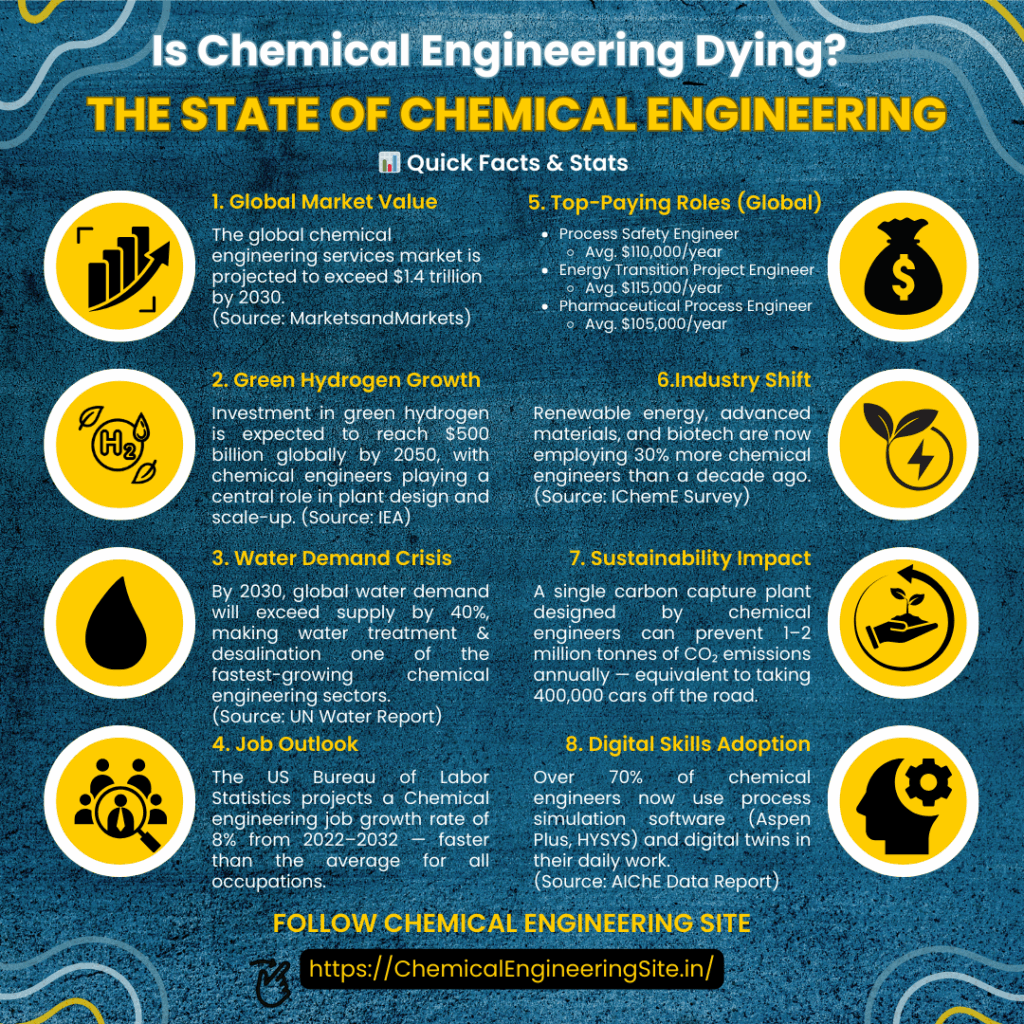
Chemical engineers are no longer just about running distillation columns or designing heat exchangers. The discipline now extends into energy transition, green technologies, biotechnology, water sustainability, and advanced materials.
Here’s where chemical engineers are thriving:
1. Sustainable Energy & Green Hydrogen
Global industries are racing to decarbonize, and chemical engineers are at the forefront of:
- Designing green hydrogen plants using electrolysis.
- Optimizing ammonia synthesis for use as a hydrogen carrier.
- Developing carbon capture and storage (CCS) systems.
These projects require deep process knowledge combined with new renewable energy integration skills — a combination uniquely suited to chemical engineers.
2. Water Treatment & Desalination
As fresh water becomes scarcer, desalination plants, wastewater treatment systems, and zero liquid discharge technologies are essential.
Chemical engineers:
- Develop and optimize membrane systems.
- Innovate dual media and multi-stage filtration systems.
- Integrate process control for sustainable water management.
The UN predicts that by 2030, water demand will exceed supply by 40% — meaning this field will grow, not decline.
3. Pharmaceutical & Bioprocess Engineering
From vaccine manufacturing to biologics production:
- Chemical engineers design bioreactors for large-scale pharmaceutical production.
- They optimize fermentation, purification, and downstream processing.
- They work in GMP (Good Manufacturing Practice) compliance and process validation.
The COVID-19 pandemic highlighted the need for rapid, large-scale production — an area where chemical engineering expertise was irreplaceable.
4. Advanced Materials & Nanotechnology
The future of batteries, electronics, and even medical implants depends on materials engineering:
- Lithium-ion and solid-state battery development for EVs.
- Nanomaterials for targeted drug delivery.
- Lightweight composites for aerospace.
Chemical engineers apply thermodynamics, reaction engineering, and materials science to bring these innovations to market.
5. AI & Digital Twins in Process Industries
Far from being replaced by AI, chemical engineers are using it to:
- Build digital twins of plants for predictive maintenance.
- Optimize process parameters using machine learning.
- Reduce downtime through predictive failure analytics.
In this way, digital tools are enhancing, not replacing, chemical engineering expertise.
Skills Modern Chemical Engineers Need
To stay competitive in this evolving landscape, chemical engineers need to adapt their skill sets:
- Core Fundamentals – Thermodynamics, transport phenomena, reaction engineering remain non-negotiable.
- Digital Skills – Process simulation (Aspen Plus, HYSYS), Python for data analysis, MATLAB.
- Sustainability Knowledge – Life Cycle Analysis (LCA), carbon footprint calculation, green process design.
- Interdisciplinary Collaboration – Working with data scientists, mechanical engineers, and environmental experts.
- Business Acumen – Understanding project economics, supply chains, and market forces.
Career Opportunities: More Diverse Than Ever
Chemical engineers now work in:
- Energy Transition Projects – Solar fuels, hydrogen economy, biofuels.
- Water Infrastructure – Desalination, wastewater recycling.
- Pharma & Healthcare – Biologics, vaccine manufacturing, process validation.
- Food & Beverage – Process optimization, safety compliance.
- Materials Science – Polymers, nanomaterials, advanced composites.
- Process Consulting – Sustainability audits, process digitalization.
In short — chemical engineering careers are diversifying, not disappearing.
The Future: Chemical Engineers as Problem Solvers
What sets chemical engineering apart is problem-solving at scale. Whether it’s climate change, energy scarcity, or food production, chemical engineers:
- Integrate knowledge from chemistry, physics, and mathematics.
- Scale up lab innovations to industrial production.
- Optimize processes for efficiency, cost, and sustainability.
In a world facing environmental crises, the demand for such problem-solving will only grow.
Why the “Obsolete” Idea is Dangerous
Believing that chemical engineering is irrelevant could:
- Discourage talented students from joining the field.
- Slow down innovation in industries that desperately need it.
- Cause companies to underestimate the importance of process expertise.
We need to shift the conversation from “chemical engineering is dying” to “chemical engineering is transforming”.
Final Thoughts
The truth is simple:
Chemical engineering is not obsolete — it is evolving to meet the needs of the 21st century.
From green hydrogen to advanced materials, from pharmaceutical breakthroughs to water sustainability, chemical engineers are leading the way.
The next generation of chemical engineers will be both process experts and digital innovators.
So, the next time someone says “chemical engineering is becoming obsolete”, remember — the world’s most urgent challenges can’t be solved without it.